I keep on seeing articles and blogs about the importance of being a content creator. This is actually one of Johnathan Zittrain's big principals for the internet - we need tech which allow us to create content and not tech which only allows us to consume it.
But more recently, curation as an alternative to content creation has become popular. Pinterest and Tumblr are both examples of this category. Hell so are search engines. Content curation is possible with many more kinds of devices than creation. It can be done using mobile devices and takes advantage passive interaction (Read Wu-Wei) such as page views.
The shift to curation is in part a response to a saturation of information on the internet. Search engines are data curation. I am hardly qualified to create new content that is worth much except in a few small areas. This blog for example is fairly worthless.
A bit more on the dark side, maybe we should flip how we think about curation from collecting good content to destroying bad content. We should be talking about content destruction. People are reluctant to see that more content is often destructive. Curation is only useful because it filters out worthless data.
Worthless data we keep on ourselves can also come back to hurt us later through data mining.

Mar 17, 2012
Nov 21, 2011
Random Name Generator

The difficulty in making an image like this, or anything like it really isn't in programming it. The program which was used to generate it is very simple. More difficult is acquiring the data. In this case, I was able to acquire the data from Wolfram|Alpha in a computable format with very little work.
For exploratory programming, acquiring data to work with is probably one of the most important issues. This is something not well addressed by most higher level programming languages. For them, the data which the code acts on is a secondary feature of the language rather than seen as an integral part of it.
Once I have access to the data, I am able to do a ton of difficult things that I would not normally be able to do. I can create a random name generator that returns realistic names back to me in the same proportion I would likely find them in the real world.
Despite the fact that the internet has brought us a ton of data to work with, finding what you want in a computable format is still very difficult. Wasn't the semantic web supposed to fix that by assigning meaning to the data?
Nov 9, 2011
Random thoughts on design methods

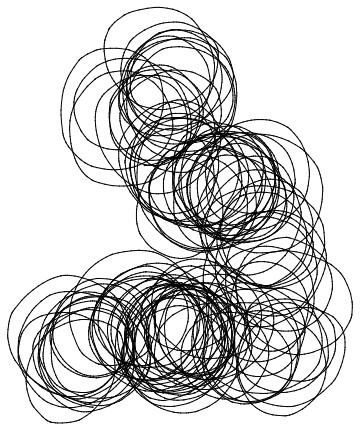
I don't really create programs anymore. Programs are restricted in what they can do. I thought for a while that I was instead creating libraries for programming. After a while though, I realized that wasn't the case either. To a certain degree, I try to think about my packages as domain specific languages. I think about creating a way to write out common concepts I need to express and build the underlying functionality in a way that will be flexible. Only after doing this a ton do I begin actually writing the thing I want.
Maybe this is just something I never really got about programming before.

But I'm not sure what it is I am really understanding except the concept of a programming language is still underrated.
MakeTurtle[] := Turtle[{0.,0.},0.,{}]; MakeTurtle[loc_,angle_,lines_]:=Turtle[loc,angle,lines];
Location[trtl_]:=trtl[[1]]; Angle[trtl_]:=trtl[[2]]; Lines[trtl_]:=trtl[[3]];
Move[trtl_,distance_]:=With[{newLoc = Location@trtl+distance*Cos[Angle@trtl],Sin[Angle@trtl]})},
MakeTurtle[newLoc,Angle@trtl,Append[Lines@trtl,Line[{Location@trtl,newLoc}]]]]
Move[distance_]:=Function[trtl,Move[trtl,distance]];
TurnRight[trtl_,angle_]:= MakeTurtle[Location@trtl,Angle@trtl+angle,Lines@trtl];
TurnRight[angle_]:=Function[trtl,TurnRight[trtl,angle]];
TurnLeft[trtl_,angle_]:= MakeTurtle[Location@trtl,Angle@trtl-angle,Lines@trtl];TurnLeft[angle_]:=Function[trtl,TurnLeft[trtl,angle]];
ShowTurtle[trtl_]:=Graphics@Lines@trtl;
trtl:=Nest[(#//TurnRight[RandomReal[{0,2Pi}]]//Move[RandomVariate[NormalDistribution[0,1]]])&,MakeTurtle[],300];
Nov 2, 2011
Some thoughts on usability of software and interfaces
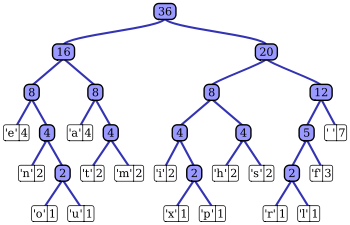 |
A good programming language for example will be a lot like a Huffman encoding. The more common a task is, the easier it should be to accomplish in that programming language. There are, of course, forces pushing to make any programming language more verbose, such as readability and desire for specificity. But this at least offers a good explanation for why there should be so many programming languages - different languages are different codings for tasks we may wish to do. Novices to programming languages wonder why there is such a diversity of programming languages since to them it seems that there is a sharp cost in learning a new programming language and that all programming languages are essentially equivalent in power (Turing complete). They attribute the diversity of programming languages to either factionalism caused by corporations or the idea that progress has been made in the design of languages, which creates new languages while legacy ones remain to and require maintenance. There is of course truth in both of these.
Not only does the Huffman code analogy help explain why there would be different languages for different areas, but it explains that some languages have different learning curves. By making it easy to do common tasks, it necessarily makes it a bit harder to do less common tasks. Many programming languages seem hard then because they try to make a large set of tasks possible with them. Take for example spread sheet programs like Microsoft's Excel. They make it very easy to make graphs of data, but it is very difficult to get highly customized graphics. In fact, there are a large number of graphics which are basically impossible to make. Creating a simple graphic with a programming language like R, Python, or Mathematica though is more difficult than doing the same task with a spreadsheet. For this reason, people new to programming think that programming languages are needlessly difficult. However, when the graphs have to be customized in some way, they are likely to find they have much more freedom and can manage much more customization with a programming language than they could have with spreadsheet. In this way, programming languages resemble Huffman coding trees that are more well balanced than more task specific programs.
The analogy with Huffman coding trees does not only extend to programming languages but other kinds of interfaces as well. Consider a simple user interface. If a certain task is more common, we can choose to make a button to perform that task more prominent than others perhaps by making it bigger or placing it at the top of a list. By doing this, we have made the other capabilities of the interface a bit harder to find. In this sense there is an encoding for the action and other actions have a longer encoding.
Aug 17, 2011
Old Dog, New Trick
I've been using integration by parts lately to solve some unique problems. Unfortunately, it seems many people don't seem to think there is anything really interesting about it. I would like to show here a simple example of some of its more complicated things I've done with it recently.
First to start off with a quick definition of the integration by parts transformation.

This transformation is kinda useful for numerical integration as well. If you look at the right hand side, you'll see that a always appears integrated. For this reason, we can use this interpretation of the integral whenever the integral of a is better behaved than a itself. Take this integral as an example:

This equation has no analytic solution and becomes very difficult to analyse numerically around 0. In fact a simple attempt to numerically integrate it won't give good results.

The oscillations are due to that problematic sine term. The amazing thing is how much better behaved the integral of sine(1/x) is than the original expression. The integral has an analytic solution in terms of the Cosine Integral function: http://mathworld.wolfram.com/CosineIntegral.html. This function is not difficult to numerically approximate.
We can then make this integral easier to solve numerically by applying the integration by parts transformation. "a" here will be Sin(1/x) and "b" will be the exponential. First we compute the Integral of a. First I define the integral of the oscillating function:

Here Ci is the previously mentioned CosineIntegral function. The full transformed integral is:

oI still oscillates, but not as widely as the previous function. This integral is easy to evaluate numerically. If we take out the analytic component and just focus on the integral, we can see we basically just transformed the function in the graph above into an analytically evaluable expression and the integral of this function:
 I'm always kind of amazed what kinds of functions this technique can be applied to.
First to start off with a quick definition of the integration by parts transformation.
This transformation is kinda useful for numerical integration as well. If you look at the right hand side, you'll see that a always appears integrated. For this reason, we can use this interpretation of the integral whenever the integral of a is better behaved than a itself. Take this integral as an example:
This equation has no analytic solution and becomes very difficult to analyse numerically around 0. In fact a simple attempt to numerically integrate it won't give good results.

We can then make this integral easier to solve numerically by applying the integration by parts transformation. "a" here will be Sin(1/x) and "b" will be the exponential. First we compute the Integral of a. First I define the integral of the oscillating function:
Here Ci is the previously mentioned CosineIntegral function. The full transformed integral is:
oI still oscillates, but not as widely as the previous function. This integral is easy to evaluate numerically. If we take out the analytic component and just focus on the integral, we can see we basically just transformed the function in the graph above into an analytically evaluable expression and the integral of this function:

Aug 7, 2011
Some fun consequences of the previous post on Cauchy distributions
Look at my kinda rant on stack exchange here.
Essentially, the theory of diversification for stocks is completely different if you assume that the differentials of stocks are Cauchy distributed instead of Normally distributed. In fact, as I kinda point out, diversification doesn't even seem to make any sense under the conditions that stocks are levy processes.
There were a number of good answers and its gonna take me a while to go through the recommended reading.
Essentially, the theory of diversification for stocks is completely different if you assume that the differentials of stocks are Cauchy distributed instead of Normally distributed. In fact, as I kinda point out, diversification doesn't even seem to make any sense under the conditions that stocks are levy processes.
There were a number of good answers and its gonna take me a while to go through the recommended reading.
Aug 1, 2011
Stocks are not Wiener Processes.
The controversy over the distribution that best fits the change of stock prices is apparently fairly recent. In turns out that stocks are actually Levy processes. I was stumbled across this fact while trying to fit the data onto the normal distribution and failing. Having read somewhere that the differential in stock prices is normal (see Black Sholes model), I assumed it would be at least a reasonable fit. After failing, I programmatically tried a ton of random distributions till a suitable fit was found.
Here is a histogram of the daily closing differences for General Electric. On top of it is superimposed a fit of the histogram with first the Normal distribution and then the Cauchy distribution. The fit was found using maximum likelihood estimation.

Of course this is not proof that the differential is Cauchy distributed. For that however you have to simply look at the properties of each distribution. For example the sum of two Cauchy random variables is another Cauchy random variable with parameters equal to the sum of the two previous parameters. Define beforehand the properties of stocks and you can derive the behavior of the distribution which should match it.
Using the normal distribution is fine if you are making some kind of approximation. However whenever an approximation is made, you have to ask how good it will be and under what conditions it fails. It looks like this hasn´t been seriously tried until recently.
Here is a histogram of the daily closing differences for General Electric. On top of it is superimposed a fit of the histogram with first the Normal distribution and then the Cauchy distribution. The fit was found using maximum likelihood estimation.

One of these is a better fit. Which do you think?
It blows my mind how terrible of a fit the Normal distribution is - why did it take Mandelbrot and Nassim Taleb to bring this fact up? In fact, running a simple test for normality on the data shows an incredibly small chance of it being normally distributed.
Of course this is not proof that the differential is Cauchy distributed. For that however you have to simply look at the properties of each distribution. For example the sum of two Cauchy random variables is another Cauchy random variable with parameters equal to the sum of the two previous parameters. Define beforehand the properties of stocks and you can derive the behavior of the distribution which should match it.
Using the normal distribution is fine if you are making some kind of approximation. However whenever an approximation is made, you have to ask how good it will be and under what conditions it fails. It looks like this hasn´t been seriously tried until recently.
Subscribe to:
Posts (Atom)